
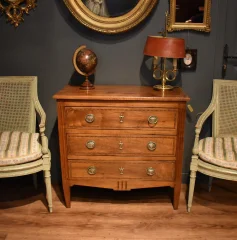
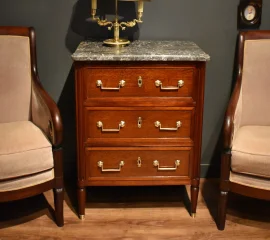
Small walnut chest of drawers
Antiquités Anne Marie Perrier — La Boisse
980,00 €
Very good condition
1105 objects found
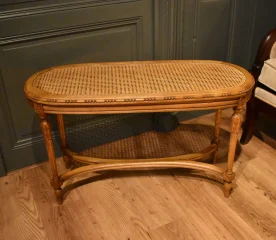
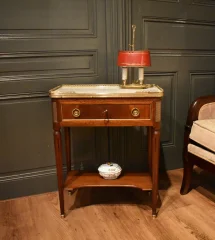
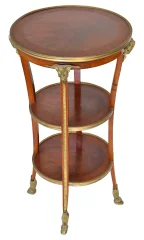
Emerging in the 1760s as a deliberate reaction against Rococo excess, the Louis XVI style brought a refined neoclassical aesthetic to French interiors: straight tapered legs, delicate fluting, oval medallions and laurel garlands drawn from Greco-Roman antiquity. Louis XVI furniture is immediately recognisable by its restrained elegance and the exceptional quality of its materials — mahogany, walnut and tulipwood enriched by finely chiselled gilt-bronze mounts.
The great cabinetmakers of the period — Riesener, Weisweiler, Saunier — produced stamped masterpieces for the French Court that remain among the most sought-after pieces in the antiques market today. Their work represents the pinnacle of French ébénisterie, bridging the Ancien Régime and the sober classicism of the Directoire style that followed.
1105 objects found
Antiquités Anne Marie Perrier — La Boisse
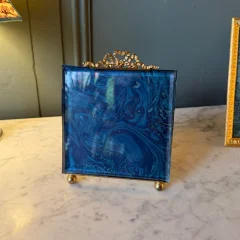
Ponvianne Antiquités — Marcy-l'Étoile
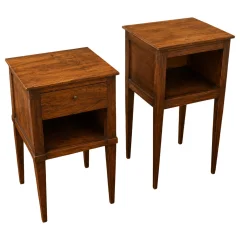
le village des brocanteurs 58 — Dun-les-Places
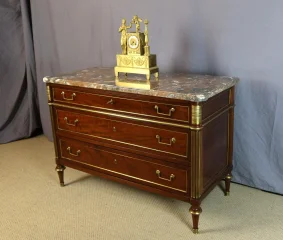
Philippe Cote Antiquites — Chauffailles
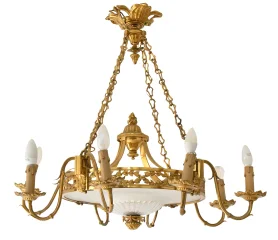
Espaces et Formes — Paris XVIII Arrdt
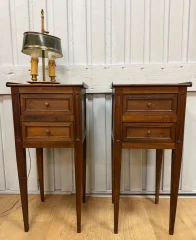
2R Antiquites — Caluire-et-Cuire
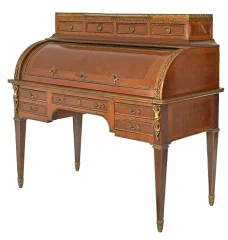
Espaces et Formes — Paris XVIII Arrdt
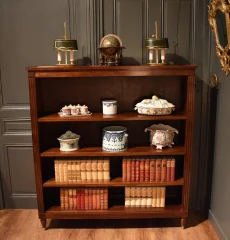
Antiquités Anne Marie Perrier — La Boisse
Antiquités Anne Marie Perrier — La Boisse
Antiquités Anne Marie Perrier — La Boisse
Antiquités Anne Marie Perrier — La Boisse
Espaces et Formes — Paris XVIII Arrdt
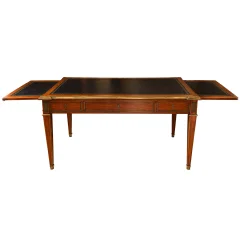
le village des brocanteurs 58 — Dun-les-Places
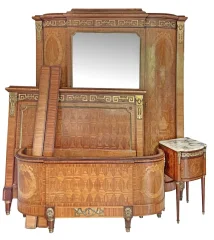
Espaces et Formes — Paris XVIII Arrdt
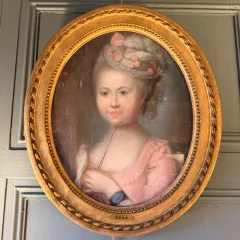
Ponvianne Antiquités — Marcy-l'Étoile
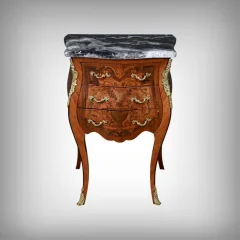
Antiquités Lecomte — Héric
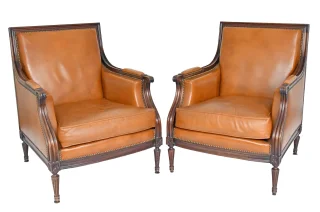
Espaces et Formes — Paris XVIII Arrdt
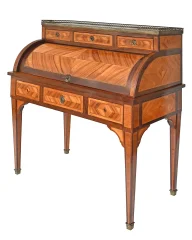
Espaces et Formes — Paris XVIII Arrdt
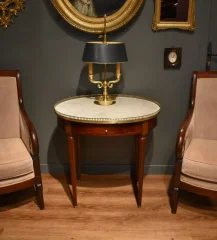
Antiquités Anne Marie Perrier — La Boisse
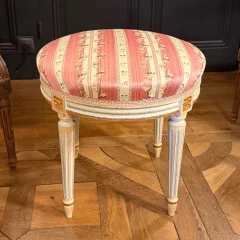
Ponvianne Antiquités — Marcy-l'Étoile
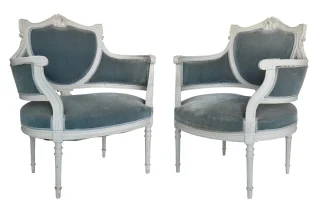
Espaces et Formes — Paris XVIII Arrdt
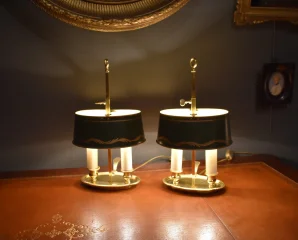
Antiquités Anne Marie Perrier — La Boisse
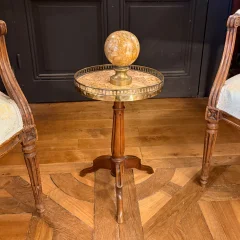
Ponvianne Antiquités — Marcy-l'Étoile
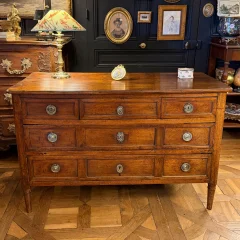
Ponvianne Antiquités — Marcy-l'Étoile
Identifying an authentic Louis XVI piece requires attention to a few key details. Start with the legs: they must be straight, tapered and fluted — never the cabriole curve associated with Louis XV. Original gilt-bronze mounts — rosettes, sabots, escutcheons — carry a warm, slightly matte mercury gilding quite unlike the bright, uniform finish of later galvanic reproductions. Look for a cabinetmaker's stamp struck on the back of a drawer or underside of the top; cross-reference it against the register of guild masters (maîtres jurés) to confirm authenticity and add significant value.
In terms of budget, a modest Louis XVI armchair or small decorative object can be found from a few hundred pounds or euros, while a stamped Riesener commode or a fall-front secrétaire with royal provenance can reach tens of thousands. Between those extremes lies a rich middle market: mahogany console tables, card tables, pier mirrors and gilt-bronze and white marble mantel clocks remain genuinely accessible to informed collectors and offer excellent long-term value.
Always examine the veneers carefully for lifting or losses, check that the bronze mounts are consistent in patina and period-correct screws, and be wary of recent paint concealing earlier repairs. A reputable dealer will readily supply raking-light photographs and close-ups of the joinery. Note that Louis XVI sits naturally alongside the Empire style that succeeded it; transitional Directoire pieces share the same neoclassical rigour and often complement a Louis XVI interior beautifully.
Every piece listed on Antiquités en France is offered by a verified professional antiquaire who can provide detailed condition reports, precise measurements and provenance documentation. Browse the selection, ask questions directly to the dealer, and find the Louis XVI antique that will enrich your home or collection for generations to come.