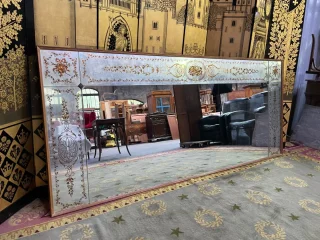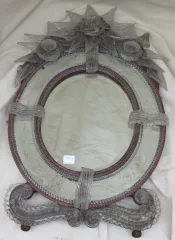
Murano beveled oval two-colour mirror
A.ABC PASCAL — Saint-Ouen
1 200,00 €
2 objects found
The Murano mirror stands among the most refined expressions of Venetian glassmaking, a tradition rooted on the island of Murano since the 16th century. Instantly recognisable by their wheel-engraved glass parecloses, tinted blown-glass frames and intricate floral or scrollwork motifs, these mirrors represent a craft found nowhere else in the world. Genuine period pieces — most often dating from the 17th or 18th century — are distinguished by the quality of their subtly aged silvering and the precision of their engraved decoration.
Whether baroque and monumental or delicately scaled in the Louis XV manner, each antique Venetian mirror carries the unmistakable character of mouth-blown glass: slight irregularities of thickness, gentle surface undulations and a warmth that no modern reproduction can replicate.
2 objects found
Authenticating a genuine antique Murano mirror requires a few key checks. Begin with the silvering: on a period piece, the backing shows characteristic iridescence, light oxidation or greyish tones typical of the mercury amalgam used before the 19th century. The glass itself, mouth-blown by a master craftsman, reveals tiny air bubbles and slight variations in thickness — hallmarks of authentic hand production. Venetian parecloses engraved on the wheel display crisp, confident motifs: acanthus leaves, rosettes, rinceaux or mythological scenes. Be wary of modern reproductions, whose glass is too uniform and whose silvering is too flawless.
In terms of style, baroque Venetian mirrors of the 17th and 18th centuries are characterised by monumental frames in cobalt blue, emerald green or amber blown glass, often embellished with applied glass flowers. The Régence and Louis XV periods also embraced these compositions, incorporating engraved parecloses within gilded boiserie surrounds. To broaden your search, explore our full selection of antique mirrors across all periods and styles.
Budget expectations vary widely. A quality 20th-century Venetian mirror can be found from around £300–£600, while a documented 18th-century piece with solid provenance may comfortably exceed £5,000–£10,000. The condition of the silvering, the integrity of the parecloses and the absence of clumsy restoration are the decisive criteria. A well-preserved baroque Venetian period mirror in exceptional condition can achieve significant prices at auction. Always ask the dealer for detailed photographs of the reverse, the frame joints and any restored sections.
On Antiquités en France, every Murano glass mirror is offered by a verified professional antique dealer who can provide precise dimensions, high-resolution photographs and full provenance details. Contact the dealer directly to discuss condition, shipping options and any additional documentation. Buying through a specialist antiquaire gives you the confidence of expert knowledge and professional accountability that private sales simply cannot match.