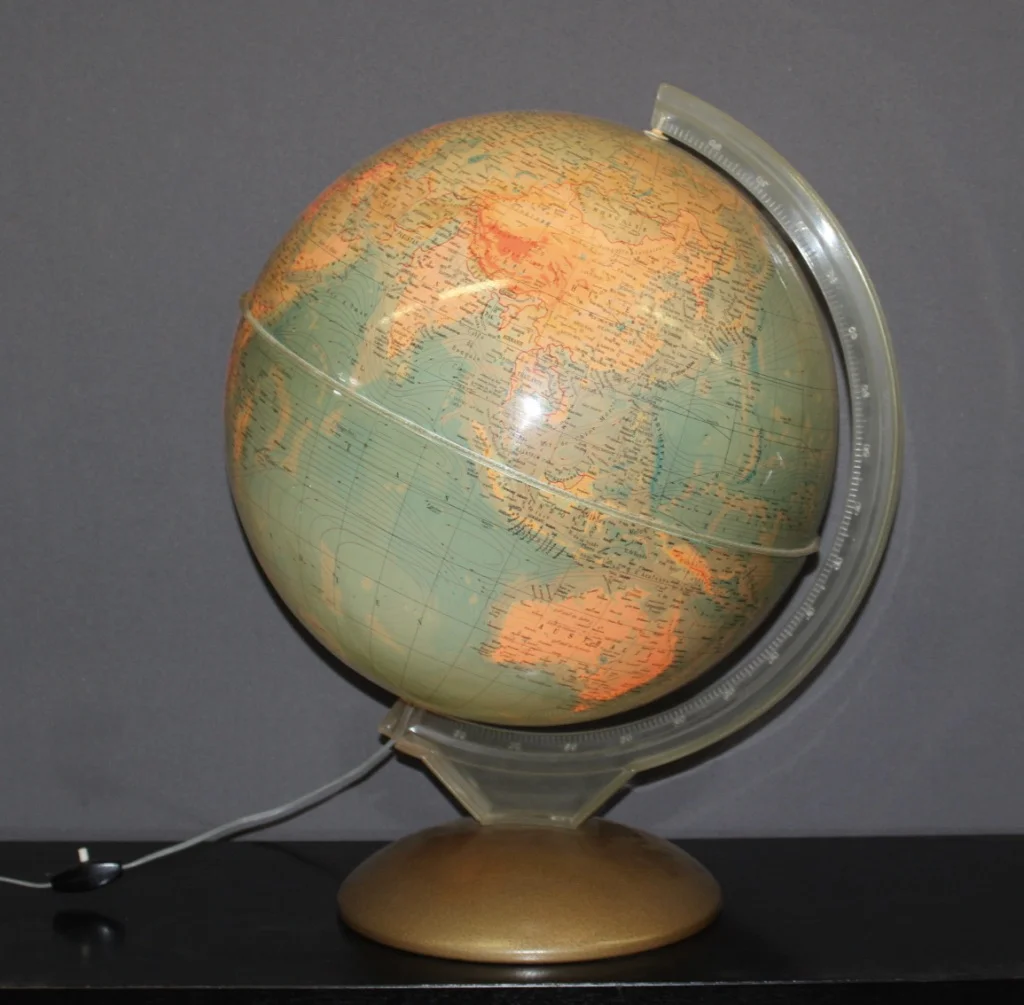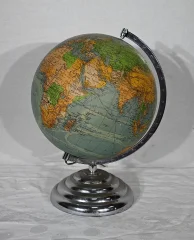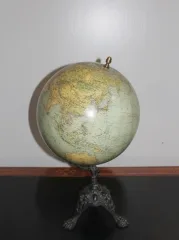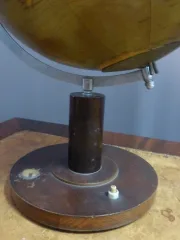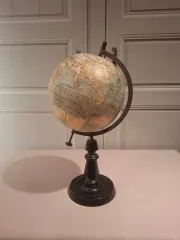
LATE NINETEENTH CENTURY GLOBE
ANTIQUITES VANGEON — Chartres
480,00 €
5 objects found
At once instruments of science and objects of prestige, antique globes embody centuries of geographical and astronomical enquiry. From the cabinet terrestrial globe to the celestial sphere mounted on a turned brass meridian, each piece reflects the state of knowledge of its era — redrawn frontiers, mythological constellations, hand-coloured cartouches. The great European publishers — Coronelli, Blaeu, Delamarche, Malby — produced celebrated series whose period examples are keenly sought by collectors today. Explore our broader selection of antique scientific instruments to complete a cabinet of curiosities.
5 objects found
Authenticating an antique terrestrial globe begins with the paper gores — the tapered strips pasted onto the sphere. On a genuine period piece, the gores are slightly convex, sometimes crazed, and printed in the warm, slightly uneven ink tones characteristic of early typographic presses. Look closely at the cartouche: it typically names the cartographer, the city of publication and the edition date. Phrases such as "Newly corrected edition" or "Augmented with the latest discoveries" can help pinpoint the publication precisely. A hand-turned brass meridian, a printed paper horizon ring and a turned mahogany or fruitwood stand are all hallmarks of careful craftsmanship.
In terms of budget, a well-preserved 19th-century cabinet globe typically sells for between a few hundred and several thousand pounds, depending on diameter, publisher and the rarity of the geographical information depicted. Matched pairs — one terrestrial, one celestial — from the same publisher command significantly higher prices. Always check the condition of the gores (lifting, losses, old repairs), the integrity of the axis and the legibility of the cartouche. An antique armillary sphere in brass or bronze, its rings tracing the great circles of the heavens, offers a compelling decorative and scientific alternative that collectors prize equally highly.
Globes sit naturally alongside antique maritime instruments and the broader world of cartography: wall maps, atlases, portolan charts and navigational instruments often form coherent thematic collections. It is well worth exploring antique maps and charts to enrich your display and deepen the historical narrative of your collection.
Every globe listed on Antiquités en France is offered by a verified professional dealer who can provide full provenance details, precise dimensions and a thorough condition report. Contact the seller directly for additional photographs or a certificate of authenticity before committing to your purchase.