
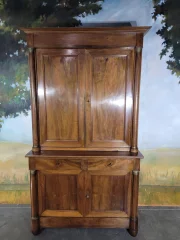
Empire two-body buffet in walnut
Antiquites d'Augers en Brie — Augers-en-Brie
1 100,00 €
Very good condition
372 objects found
Emerging under the Consulate and the First Empire (1799–1815), Empire style furniture embodies Napoleonic grandeur: severe straight lines, strict symmetry, and an abundant use of Cuban mahogany paired with gilt bronze mounts cast as sphinxes, winged victories and laurel wreaths. Master cabinetmakers Jacob-Desmalter, Bellangé and Marcion defined the period's aesthetic, drawing freely from Greco-Roman and Egyptian antiquity.
Recognisable by its sabre legs, engaged columns and warm gilding set against dark wood, the Empire style spans chairs and sofas, secretaires, mirrors and mantel clocks. It marks a clear departure from the lighter, less symbolically charged Directoire style that preceded it.
372 objects found
Antiquites d'Augers en Brie — Augers-en-Brie
le village des brocanteurs 58 — Dun-les-Places
le village des brocanteurs 58 — Dun-les-Places
le village des brocanteurs 58 — Dun-les-Places
le village des brocanteurs 58 — Dun-les-Places
le village des brocanteurs 58 — Dun-les-Places
le village des brocanteurs 58 — Dun-les-Places
le village des brocanteurs 58 — Dun-les-Places
le village des brocanteurs 58 — Dun-les-Places
le village des brocanteurs 58 — Dun-les-Places
le village des brocanteurs 58 — Dun-les-Places
le village des brocanteurs 58 — Dun-les-Places
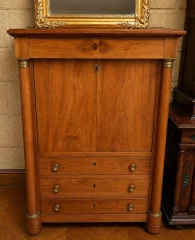
le village des brocanteurs 58 — Dun-les-Places
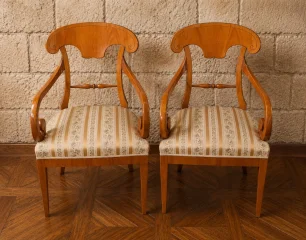
le village des brocanteurs 58 — Dun-les-Places
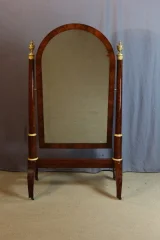
Philippe Cote Antiquites — Chauffailles
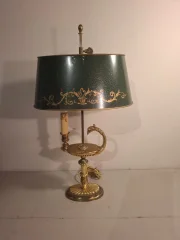
ANTIQUITES VANGEON — Chartres

Ponvianne Antiquités — Marcy-l'Étoile
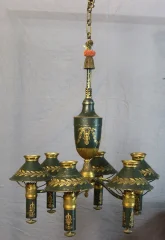
Philippe Cote Antiquites — Chauffailles
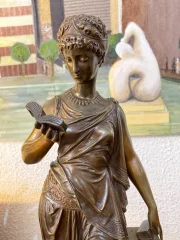
jean-pierre PERNOD — Bourg-en-Bresse

Antiquités Lecomte — Héric
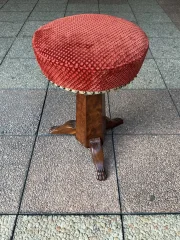
Eric Saget — Paris
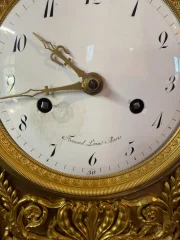
Romain Lichtensztein — Maignelay-Montigny
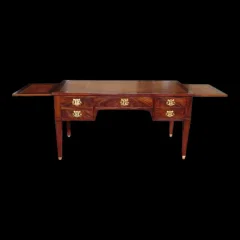
L'atelier De La Dorure — Calmont
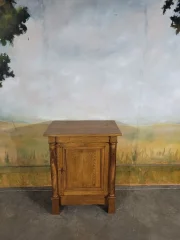
Antiquites d'Augers en Brie — Augers-en-Brie
Authenticating a genuine Empire period piece begins with the mahogany: original examples use tightly grained Cuban or Santo Domingo mahogany, typically as veneer over oak or in solid form for structural elements. The gilt bronze mounts are equally telling — mercury gilding, the standard process before it was abandoned around 1830 on health grounds, produces a warm, slightly matte gold entirely unlike the brighter, cooler finish of electroplated reproductions from the Second Empire or later. A hot-iron cabinetmaker's stamp — Jacob-Desmalter, Bellangé, Lemarchand — found on the back of a drawer or beneath a rail is a strong indicator of quality and period authenticity.
In terms of budget, Empire pediment mirrors and smaller decorative objects can be found from a few hundred pounds or euros, while a stamped drop-front secretaire or a canopied bed by a named maker may comfortably exceed ten thousand. Empire gilt bronze mantel clocks — frequently featuring mythological figures — remain highly sought after; the quality of the chasing and the clarity of the subject matter are the key value drivers. Always check that the bronze mounts are original (look for period screws and a consistent patina), that the veneer is sound with no lifting or losses, and that the joints are stable.
The Empire style spread across Napoleonic Europe, giving rise to closely related national variants: Biedermeier in the German-speaking world and Regency in Britain, all sharing the same Neoclassical vocabulary. On Antiquités en France you will also find pieces from the Louis-Philippe period, which softened and prolonged the Empire aesthetic after 1830, making it a natural next step for collectors.
Every dealer listed on our platform is a verified professional able to provide detailed photographs, provenance documentation and care advice. Contact them directly before purchasing — they are the best guide to condition, restoration history and fair market value for any Empire antique you have in mind.