
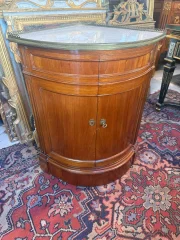
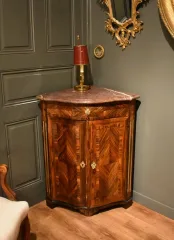
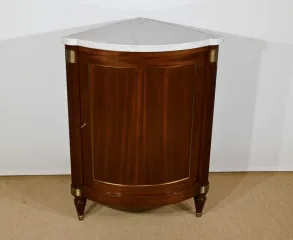
Louis XVI Style Corner Cabinet
Romain Lichtensztein — Maignelay-Montigny
650,00 €
Good condition
54 objects found
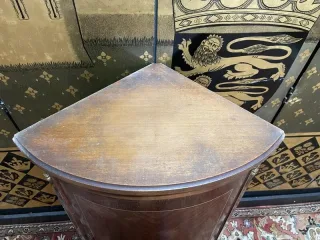
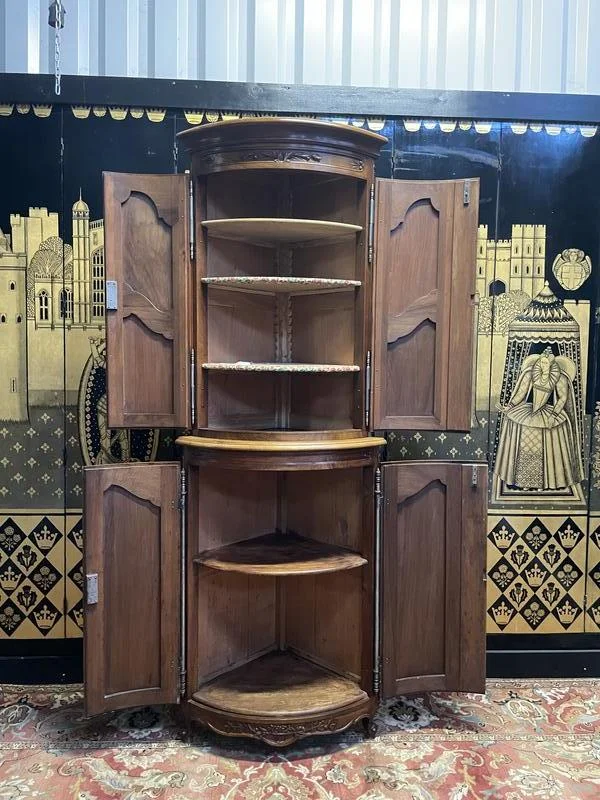
The antique corner cabinet — known in French as an encoignure — was designed to fit flush into a 90-degree corner, combining space efficiency with refined decorative presence. Emerging in the early 18th century, it reached its peak under Louis XV and Louis XVI, when master ébénistes competed in ingenuity: marquetry corner cabinets veneered in exotic woods, Far Eastern lacquer panels, and finely chased gilt-bronze mounts. They are instantly recognisable by their triangular or quarter-circle plan, their bowed or straight doors, and their fitted interior shelves.
Most often sold in matching pairs, they were a cornerstone of symmetrical arrangement in classical and neoclassical French interiors. Every piece listed here is selected by a verified professional antique dealer who stands behind its authenticity.
54 objects found
Romain Lichtensztein — Maignelay-Montigny
Antiquites d'Augers en Brie — Augers-en-Brie
Eric Saget — Paris

Philippe Cote Antiquites — Chauffailles
L’ESTAMPILLE — Navilly

Philippe Cote Antiquites — Chauffailles

Antiquités Lecomte — Héric
L’ESTAMPILLE — Navilly
2R Antiquites — Caluire-et-Cuire
Antiquités Anne Marie Perrier — La Boisse
L’ESTAMPILLE — Navilly
L’ESTAMPILLE — Navilly
L’ESTAMPILLE — Navilly
L’ESTAMPILLE — Navilly
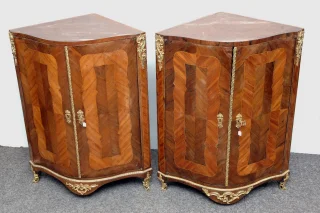
Antiquités GUY Jacques — Buchères
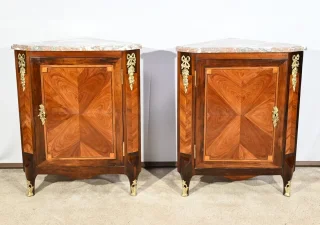
Antiquités Lecomte — Héric
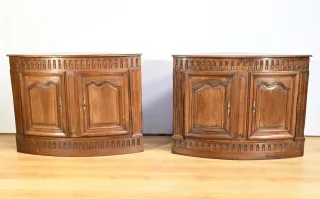
Antiquités Lecomte — Héric
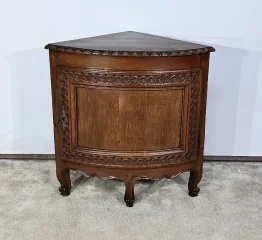
Antiquités Lecomte — Héric
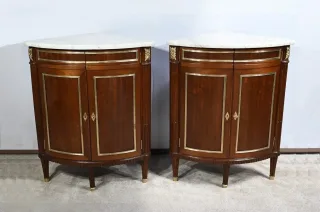
Antiquités Lecomte — Héric

Anne Besnard — Saint-Ouen
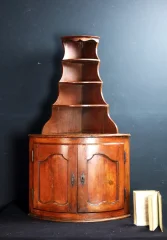
Philippe Cote Antiquites — Chauffailles
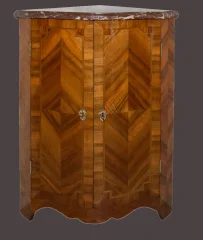
Galerie Lauretta — Mandelieu-la-Napoule
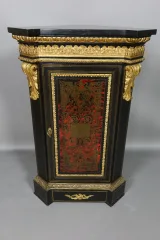
Philippe Cote Antiquites — Chauffailles
Antiquités Lecomte — Héric
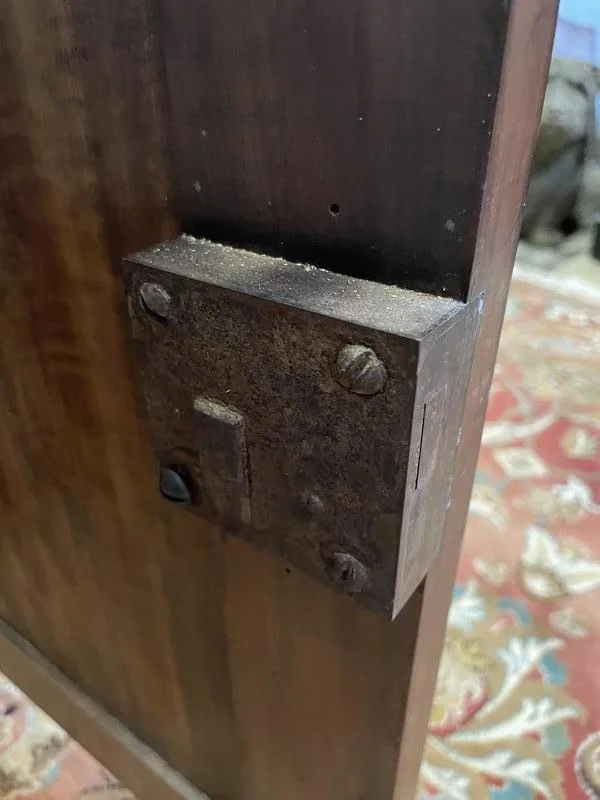
Authenticating a period corner cabinet begins with the construction. Hand-cut dovetail joints with slight irregularities, secondary timbers such as oak, poplar or pine for the carcass, and visible tool marks on interior surfaces all point to genuine 18th- or early 19th-century craftsmanship. An ébéniste's stamp — struck into the frame or underside of the top — adds significant value; names to watch for include Roger Vandercruse dit Lacroix (RVLC), Pierre Macret, and the celebrated workshops of the Faubourg Saint-Antoine in Paris.
Materials and ornament help date a piece precisely. Lacquer panels and gilt-bronze mounts with flowing, asymmetric motifs signal the Louis XV style, while straight fluting, bead-and-reel friezes, and matte-finish bronzes are hallmarks of Louis XVI. Charles X examples favour spotted maple or lemonwood veneers with restrained brass inlay. Always check that the bronze mounts are original — consistent patina, period screws, and undisturbed gilding are reassuring signs — and assess the veneer carefully: localised lifting is repairable, but a wholesale re-veneer significantly reduces value.
Budget expectations vary widely. A provincial 19th-century walnut corner cabinet can be found from a few hundred pounds or euros, while a stamped, matched pair in rosewood marquetry with original gilt-bronze mounts may command tens of thousands. Pairs are always more sought-after than single examples — their combined value routinely exceeds twice that of a lone piece — so acquiring a pair when the opportunity arises is generally sound collecting practice. For related pieces, explore our Louis XVI corner furniture listings to broaden your search.
On Antiquités en France, every antique encoignure is offered by a vetted professional dealer who can supply detailed photographs, exact dimensions, and full provenance information. Contact the seller directly for shipping quotes — many pieces can be carefully packed and delivered across Europe and beyond.