
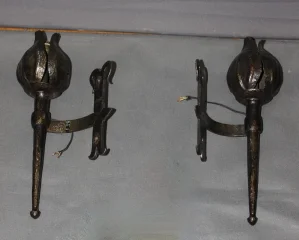
Pair of Medieval-style wrought iron wall lights, signed Reboulet, 20th century
Antiquités Christophe Rochet — Villeurbanne
320,00 €
Very good condition
87 objects found
The term Haute Époque covers European works of art and furniture produced from the Middle Ages through the end of the Renaissance — roughly the 11th to the early 17th century. Solid oak chests with carved panels, Gothic polychrome wood sculptures, church stalls, trestle tables and credences form the heart of this category. These pieces are recognised by their robust joinery, their religious or heraldic iconography, and the incomparable patina that only centuries of age can bestow.
Among the most prized by serious collectors are works in the Gothic style, whose pointed arcading and foliate carving remain instantly distinctive.
87 objects found
Antiquités Christophe Rochet — Villeurbanne
Philippe Cote Antiquites — Chauffailles
Philippe Cote Antiquites — Chauffailles

Philippe Cote Antiquites — Chauffailles

Antiquités Lecomte — Héric
Philippe Cote Antiquites — Chauffailles
Philippe Cote Antiquites — Chauffailles
French-antiques.fr — Rouen

Philippe Cote Antiquites — Chauffailles
Eric Saget — Paris
Antiquités Lecomte — Héric
Antiquités Lecomte — Héric
Espace Tapisseries Aubusson - La Galerie Dor — Aubusson

L’ESTAMPILLE — Navilly
L’ESTAMPILLE — Navilly

L’ESTAMPILLE — Navilly
L’ESTAMPILLE — Navilly
L’ESTAMPILLE — Navilly
L’ESTAMPILLE — Navilly
L’ESTAMPILLE — Navilly

L’ESTAMPILLE — Navilly
L’ESTAMPILLE — Navilly
L’ESTAMPILLE — Navilly

L’ESTAMPILLE — Navilly
Authenticating a piece of Haute Époque furniture or sculpture calls for both method and experience. Begin with the construction: mortise-and-tenon joints secured with wooden pegs, tool marks left by adzes and chisels, and the natural irregularity of hand-sawn planks are all reliable indicators of genuine age. Oak dominates — particularly in French and Flemish pieces — while walnut asserts itself from the Italian and French Renaissance onward; chestnut and elm appear in rural regional work. A deep, even patina that has not been over-waxed or stripped is one of the clearest signs of authentic ageing.
In terms of ornament, Renaissance carved panels display scrollwork, pilasters, grotesque masks and all'antica medallions, while the Gothic repertoire favours pointed arcades, leafy rinceaux and figures of saints. A documented provenance — a château inventory, an ecclesiastical collection, an old auction record — adds considerably to both the value and the security of any purchase.
Prices range from a few hundred pounds for a small architectural fragment or carved element, to tens of thousands for a large Renaissance oak chest with figurative decoration or a museum-quality polychrome statue. Always check the condition of the joints, confirm the absence of active woodworm, and assess whether any restorations are consistent with the original period. Pieces with clear exhibition or collection histories command a premium and are easier to resell.
On Antiquités en France, every Haute Époque antique is offered by a verified professional dealer who can supply detailed photographs, condition reports and provenance documentation. To broaden your search into neighbouring periods, explore Directoire furniture or Empire-period works — and contact your chosen dealer directly for any valuation or expertise enquiry.