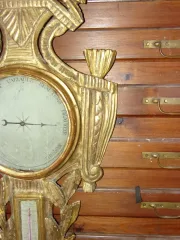
Authenticating an antique barometer begins with the maker's signature or engraved nameplate, typically found on the dial or the brass register plate. The leading London and Paris workshops of the 18th and 19th centuries invariably stamped their name and street address; a legible signature consistent with the period is one of the strongest indicators of genuine provenance. Check that the materials are coherent: a moulded mahogany or walnut case, gilt brass columns and a hand-blown glass tube are hallmarks of a quality period piece.
For
antique marine barometers, the gimbal suspension — allowing the instrument to hang vertically at sea — is a defining feature and a significant value driver. On mercury models, inspect the tube carefully: any air bubble or crack compromises both accuracy and value.
Combined barometer-thermometer sets in carved wood cases are especially prized by collectors and represent some of the most decorative examples available.
In terms of budget, a good Victorian aneroid salon barometer typically sells for £150–£500, while a signed mercury barometer by a prestigious maker — Negretti & Zambra, Naudet, Casella — can command £500 to several thousand pounds, with exceptional marine examples carrying original gimbal brackets reaching higher still. The presence of a fitted case, original documentation or a traceable provenance adds meaningfully to the price. Avoid pieces where the case has been repainted or the scale re-engraved: such interventions undermine authenticity and are difficult to reverse.
Every
antique barometer listed on Antiquités en France is offered by a verified professional dealer who can supply detailed photographs, exact dimensions and the instrument's history before you commit to a purchase. You may also wish to explore our
antique marine instruments section for complementary navigational pieces. Contact the dealer directly — they are the best guide to condition, restoration history and shipping options.