
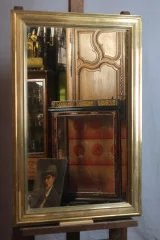
Brass bistro mirror
Philippe Cote Antiquites — Chauffailles
680,00 €
Very good condition
14 objects found
Antique mirrors rank among the most sought-after pieces in decorative French furniture. From the restrained parclose mirrors of the Régence period to the magnificent gilt trumeaux of the 18th century, each era developed its own ornamental vocabulary: carved and gold-leaf gilded wood, stucco frames, bevelled or engraved mercury glass. In any interior, they bring light, depth and character while representing a lasting investment.
On Antiquités en France, period mirrors are offered exclusively by verified professional antique dealers who stand behind the authenticity and provenance of every piece.
14 objects found
Philippe Cote Antiquites — Chauffailles
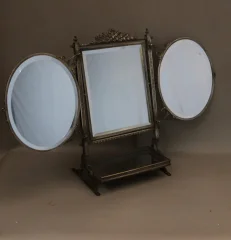
Philippe Cote Antiquites — Chauffailles
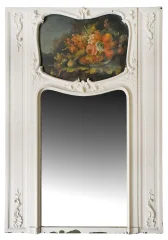
Espaces et Formes — Paris XVIII Arrdt
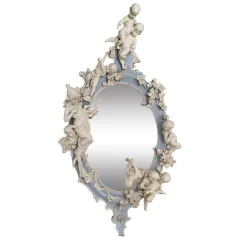
Les Trésors d'avril 71. — Saint-Bonnet-de-Vieille-Vigne
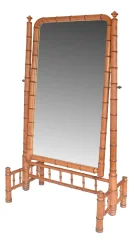
Espaces et Formes — Paris XVIII Arrdt
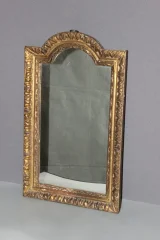
Antiquités Christophe Rochet — Villeurbanne
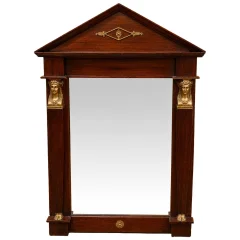
Les Trésors d'avril 71. — Saint-Bonnet-de-Vieille-Vigne
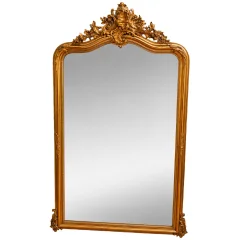
Les Trésors d'avril 71. — Saint-Bonnet-de-Vieille-Vigne
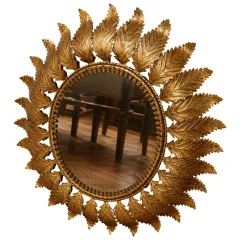
Les Trésors d'avril 71. — Saint-Bonnet-de-Vieille-Vigne
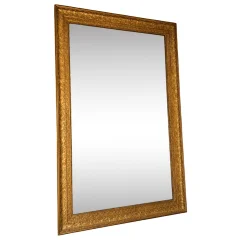
Les Trésors d'avril 71. — Saint-Bonnet-de-Vieille-Vigne
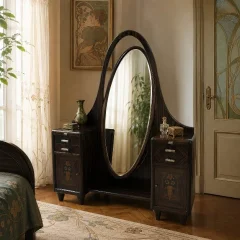
L'atelier De La Dorure — Calmont
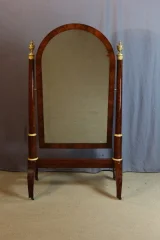
Philippe Cote Antiquites — Chauffailles
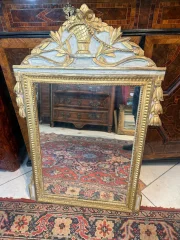
Romain Lichtensztein — Maignelay-Montigny

Romain Lichtensztein — Maignelay-Montigny
Identifying a genuinely antique mirror requires examining several telling details. Mercury glass — characteristic of pieces made before the 20th century — shows slightly grey or warm-toned reflections, faint iridescence and often small oxidation spots around the edges. These natural imperfections are impossible for modern reproductions to replicate convincingly. The frame deserves equal scrutiny: on an authentic gilt trumeau mirror, gold-leaf gilding displays a warm, uneven patina with natural wear at the corners and raised details — quite unlike the flat, uniform finish of chemical gilding on later copies.
In terms of style, the Louis XVI mirror is defined by straight fluting, bead-and-reel friezes and neoclassical medallions, while Napoleon III examples favour ebonised or gilded frames adorned with acanthus leaves and cartouches. Antique overmantel mirrors with sculpted pediments — often monumental in scale — make commanding focal points in rooms of character. For those drawn to more intimate formats, parclose mirrors, composed of several glass panels separated by narrow mouldings, offer a refined understatement that interior designers consistently prize.
Budget expectations vary widely: from a few hundred pounds or euros for a sound 19th-century mirror in a common style, to several thousand for a signed period trumeau or a piece with documented royal or aristocratic provenance. Always check the structural integrity of the frame, the condition of the gilding and whether the glass is original. A well-executed period restoration is perfectly acceptable; a recently replaced glass, however, meaningfully reduces the piece's heritage value and resale potential.
Every antique mirror listed on Antiquités en France is offered by a verified professional dealer able to provide detailed photographs, precise dimensions and full provenance information. You may also wish to explore our selection of solid silver objects or antique watercolours and gouaches to complete a coherent decorative scheme. Contact your chosen dealer directly for condition reports, shipping quotes or authentication advice.